Knowledge panels
What is a Google knowledge panel, and why don't you have one?
A plain explanation of the Google knowledge panel, where it comes from, why most people never get one, and how to check whether Google has an entity for you.
A client before the call. A producer before the booking. A journalist before the quote. They check the AI first now, and for most experts it hesitates, picks the wrong person, or describes a job you left years ago. MeMyself makes you the one person it is sure about.
$2,500 setup. Live in 30 days with your first published interview, or your money back.
The first impression changes everywhere your name gets typed, and it starts working before you are in the room.
For a name search the AI answer is the whole page. With a record, that page says your role, your company, your book and your last three shows, and cites you as the source.
Hosts, producers and event organizers check you before they reply. A page with your topics, your intro and your last ten appearances is the easiest yes they will give all week.
The dentist, the footballer, the other consultant. One record, one name form everywhere, and the AI stops guessing which of you it is talking about.
An episode is a dated, third party page that vouches for you. Collected on your record, each one makes the next one count for more. Lost, it evaporates in a week.
Ask an assistant about the founder you pitch against, the speaker competing for your slot, the author whose book sits next to yours, and it answers in full, with sources. Ask it about you and it shrugs. The difference is not talent or track record. It is whether Google and the AI assistants have a record they trust. When a client checks both of you, one of you exists.
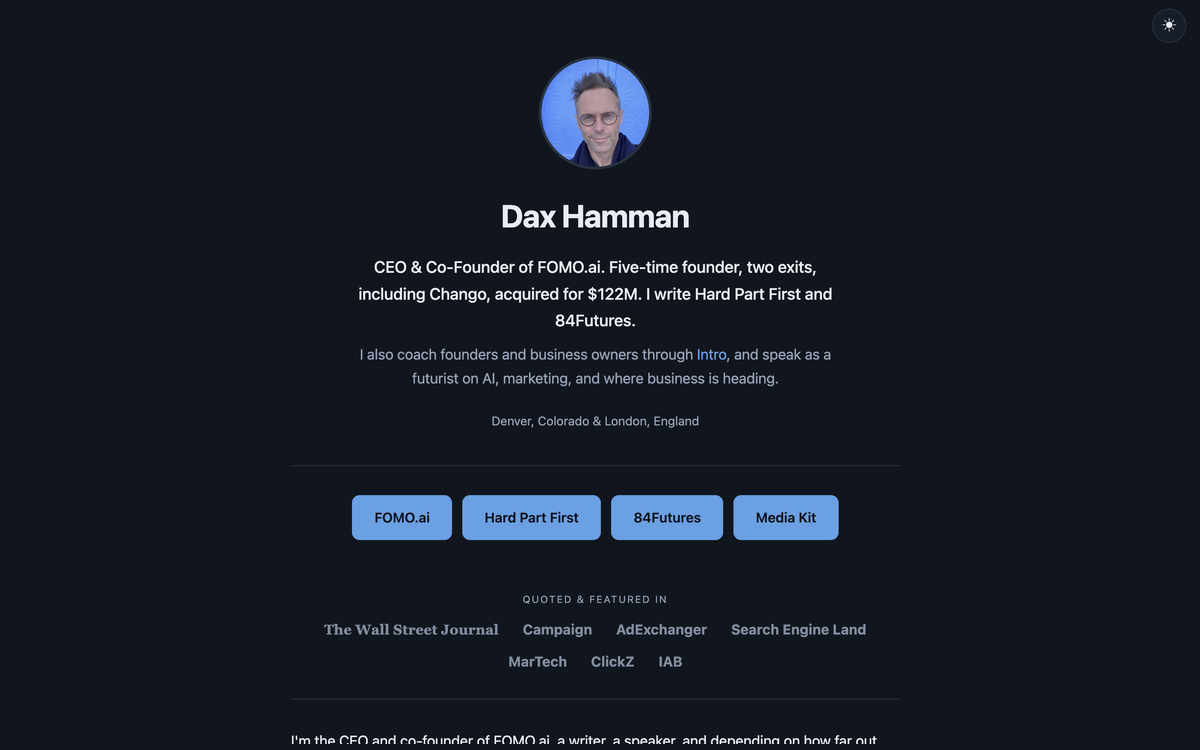
Hard to find, and easy to get wrong. Google had split him into two entities, one of them fed by a 2014 author bio that still said CSO at Chango. While fundraising, investors who looked him up got conflicting answers about what he did now. Podcast hosts who checked found an old title and a dead link, and some never booked. Because the facts did not agree, Google ignored most of what was true.
One record on dax.fyi, every profile matching it, a Wikidata entry referenced claim by claim, his interviews collected in one place. Google merged the entity and he claimed the knowledge panel in September 2026. Ask any assistant now and it names FOMO.ai, the Chango exit, Hard Part First and 84Futures, and cites his own site.
Google, ChatGPT and the other assistants do not read your website the way a person does. Underneath the words there is a hidden layer (called schema) where a page describes who someone is in a form Google and AI can trust: this is a person, they work here, they wrote this book, and these profiles all belong to the same human.
That hidden layer is how the web, Google and the AI models keep track of people and companies (entities). When it is missing they guess, and they guess from whatever they can find. When it is there, and every source agrees with it, they are sure. Most personal websites have none of it.
A Google knowledge panel, a Wikidata entry, a Wikipedia article. We never promise any of them, because we do not decide them. Google decides who gets a panel and Wikipedia's editors decide who gets an article. What we can say is that the record is the foundation those outcomes are built on, it is the same work the specialist services charge five figures for, and for some clients it has led there.
Google builds one when enough trusted sources agree about who you are. The record, the matching profiles, the collected interviews and the Wikidata entry are exactly that agreement. When a panel appears we walk you through claiming it, and after the claim you control the photo, the subtitle and the links.
Wikidata is the open database behind Wikipedia, and Google treats it as a source it trusts. Where you qualify, with at least one independent outlet having written about you, we create and reference the entry as part of the setup. It is often the first thing to move attributes like education and birthplace into a panel.
Wikipedia's bar for a living person is high and we will tell you plainly whether you clear it. If you do, the record and the collected coverage are what an article is written from, and we will never edit it on your behalf; that is the one thing that gets articles deleted. If you do not, the panel and the Wikidata entry do most of the same work.
The first step does most of the work, and it is the one you will enjoy.
A recorded conversation, published as a real podcast episode. It becomes your first third party appearance, and the questions are built to draw out what is not online about you yet, because that is what Google rewards most.
We turn the interview, your bio and your links into a fact set you approve line by line. Nothing unconfirmed goes live. Then we make every profile you own agree with it.
Your site on your domain with the full hidden graph, a media kit a producer can book from, Wikidata where you qualify, Search Console, one press release, and screenshots of what every assistant said about you on day one.
Once you go live, choose how fast you want to grow your presence.
Founders, authors and executives who are now the person Google and AI are sure about.





Step one: the Foundation
Live on your domain with your first published interview inside 30 days, or your setup fee back.
Step two: keep it going
The Foundation builds your record. A monthly plan keeps it online, keeps it true, or builds the evidence around it. Every plan includes the Claim Yourself course.
Your site stays online and kept to spec.
For people who have their record and want it live and in spec. $270 a year if paid annually.
Your record stays true as your career moves.
The usual choice, for anyone whose work keeps moving. $1,490 a year if paid annually.
Builds the outside evidence Google and AI read.
For people ready to be found as the authority in their field.
Learn exactly what Google and Wikipedia look for, and whether you meet it: how Google decides who you are, what counts as independent evidence, Wikidata, claiming a knowledge panel, Wikipedia's criteria and the proper routes, and a readiness scorecard that tells you plainly where you stand. We teach the criteria. Google and Wikipedia's editors make the decisions.
Add to any plan: podcast placements, about $450 each. Press releases, $495 each. Launching a book, a fund or a practice? Talk to us about a custom plan.
We never buy links, use link networks or run mass guest post campaigns. Every outside reference we earn is editorial.
IncludedNot included
| Foundation$2,500 once | Maintain$27 a month | Evolve$149 a month | Authorityfrom $595 a month | |
|---|---|---|---|---|
| Site, record, hidden layer and media kit | Built | Kept live and to spec | Kept true as you change | Kept true as you change |
| Hosting, SSL and uptime | At launch | Included | Included | Included |
| Quarterly health check: links, speed, indexing | Not included | Included | Included | Included |
| New appearances, writing, roles and projects added | Not included | Not included | Up to four updates a month | Included |
| Search Console | Set up, indexing requested | Quarterly check | Monthly report | Monthly report |
| AI answer check | Day one and day 90 | Not included | Quarterly | Monthly |
| Knowledge panel | Everything Google reads to build one | Not included | Monthly watch and help claiming it | Plus duplicate reports and stale bio chasing |
| Wikidata | Created if you qualify | Not included | Kept in agreement with your record | Path built, filed once you qualify |
| Readiness check against the Wikidata and Wikipedia criteria | Day 90 | Not included | Quarterly | Quarterly, reviewed with you |
| Press releases | One | Not included | One a year | Up to one a quarter |
| Earned references | Not included | Not included | Show notes and your own properties corrected | Contributed pieces, expert quotes, relevant associations and directories |
| Quarterly conversation | Not included | Not included | Not included | Included |
| Claim Yourself course | Included | Included | Included | Included |
| Recorded interview and positioning session | Included | Not included | Not included | Not included |
No WordPress, no Squarespace, no Wix, no GoDaddy builder. Those platforms are frameworks from an older web: they sit between you and your page, add weight you never asked for, and were not designed for how Google and the AI assistants read a site today. Your site is pure. Just your pages, your words and the hidden layer the assistants read, with nothing else inside it, served from Cloudflare's global network from the location nearest whoever is looking.
Nobody can promise that. Google builds the entity on its own schedule and shows the panel when it is confident. We build the record it reads, make every source agree, and teach the claim process for the day it appears.
The Foundation, delivered in 30 days: a recorded interview published as an episode, your record, a site on your own domain with the hidden layer and a media kit, a consistency pass across your profiles, Wikidata where you qualify, Search Console, one press release, an AI answer check at day one and day 90, a readiness check against the Wikidata and Wikipedia criteria, a positioning session and the Claim Yourself course. Live in 30 days with your first published interview, or your setup fee back.
Maintain ($27 a month) keeps your site hosted, live and kept to spec. Evolve ($149 a month) also adds your new appearances, writing and roles and watches for your knowledge panel. Authority (from $595 a month) also builds outside evidence: pitches, press releases and corrections to stale bios. Every plan includes the Claim Yourself course.
Our course on how Google, Wikidata and Wikipedia decide who gets an entry: the criteria, what counts as independent evidence, the proper routes, and a readiness scorecard that tells you plainly whether you are ready. It is included with every plan. It teaches how those decisions are made; we do not promise their outcome.
Good. If it states your facts plainly, carries one Person node with sameAs links, lists your appearances and your profiles all agree with it, you may not need the Foundation. Most personal sites do none of those. Schedule a call and we will tell you honestly.
Yes. The point is one address you control that everything else points at. If you do not have one, we help you choose and buy it, and you keep the registration. Hosting is included in every monthly plan.
The site is live in 30 days. Assistants that search the web live reflect it within weeks of indexing. The ones answering from training data catch up when their models refresh, which can take months. The 90 day check shows you which is which.
You keep an export of your record and the site files and can host them anywhere. Hosting, updates, reports and outside work stop.
Plain explanations with diagrams and steps. No pitch inside; the footer does that.
A plain explanation of the Google knowledge panel, where it comes from, why most people never get one, and how to check whether Google has an entity for you.
A small text file at the top of your site that tells an AI agent who you are and where the facts live. What it is, where it came from, what it does and does not do, what goes in one for a person, and an example you can copy.
Registrars, DNS, nameservers, hosting, speed scores, and why we build personal sites pure, with no platform underneath, on Cloudflare rather than WordPress, Squarespace or Wix. No prior knowledge assumed.